Last Updated:
Voyager 1 is en route to set a new milestone as it will be placed one light-day away from Earth in 2026.

Voyager 1 will hit one light-day distance from Earth soon. Here’s what that means. (NASA)
Snapped on February 14, 1990, “The Pale Blue Dot” remains the greatest photograph of Earth, secured in the archives of humanity. Voyager 1, then at 6 billion kilometres from the Sun, turned back to take photographs. Among them was “The Pale Blue Dot” which showed Earth as a speck, basking in the scattered sunlight. “Look again at that dot. That’s here. That’s home. That’s us,” Carl Sagan famously described the photo in his book “Pale Blue Dot: A Vision of the Human Future in Space”.
That remains just one of the many achievements in Voyager 1’s illustrious resume, the spacecraft currently 15.79 billion miles (25.3 billion km) from Earth. However, this time next year, the probe will enter history when it clocks one light-day.
Voyager 1
Voyager 1 left Earth in 1977 to study our solar system. Although launched after Voyager 2, Voyager 1’s faster route enabled it to overtake its sibling on December 15, 1977.
The spacecraft, during its Saturn flyby, discovered five new moons and a ring named G-ring. When visiting Jupiter, it discovered a thin ring around the gas giant and also noted the presence of two new Jovian moons, namely Thebe and Metis.
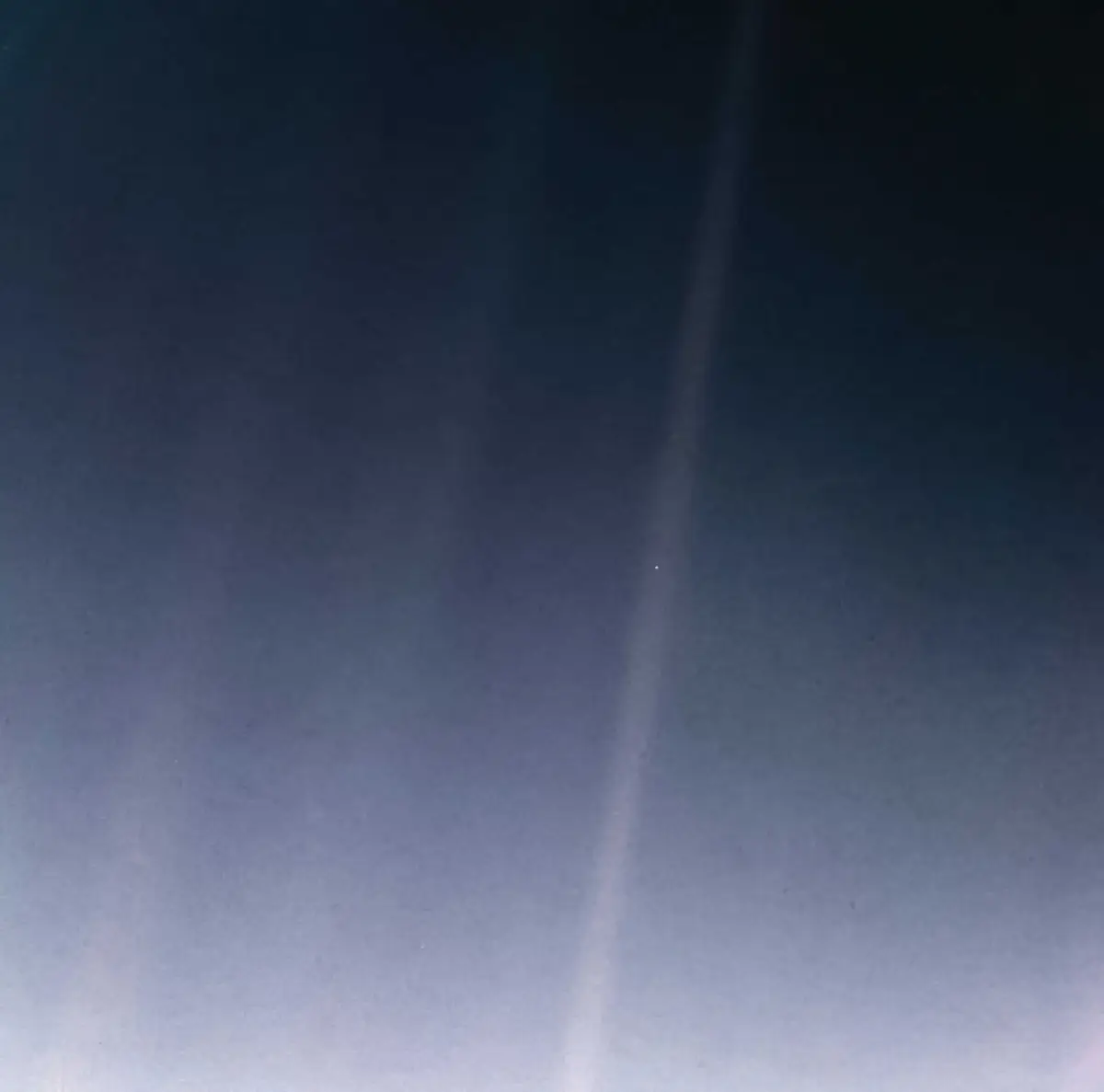
Pale Blue Dot: NASA/JPL-Caltech
On February 17, 1998, Voyager 1 became the most distant human-made object in our solar system at a distance of 69.4 AU from the Sun. Later, on August 25, 2012, the spacecraft entered interstellar space.
In 2025, it’s still alive and kicking.
“Voyager 1 continues to communicate with NASA’s Deep Space Network and send data back from four still-functioning instruments — the cosmic ray telescope, the low-energy charged particles experiment, the magnetometer, and the plasma waves experiment,” NASA noted.
The Voyager mission was led by John R. Casani, the project manager who enabled humanity to explore the cosmos.
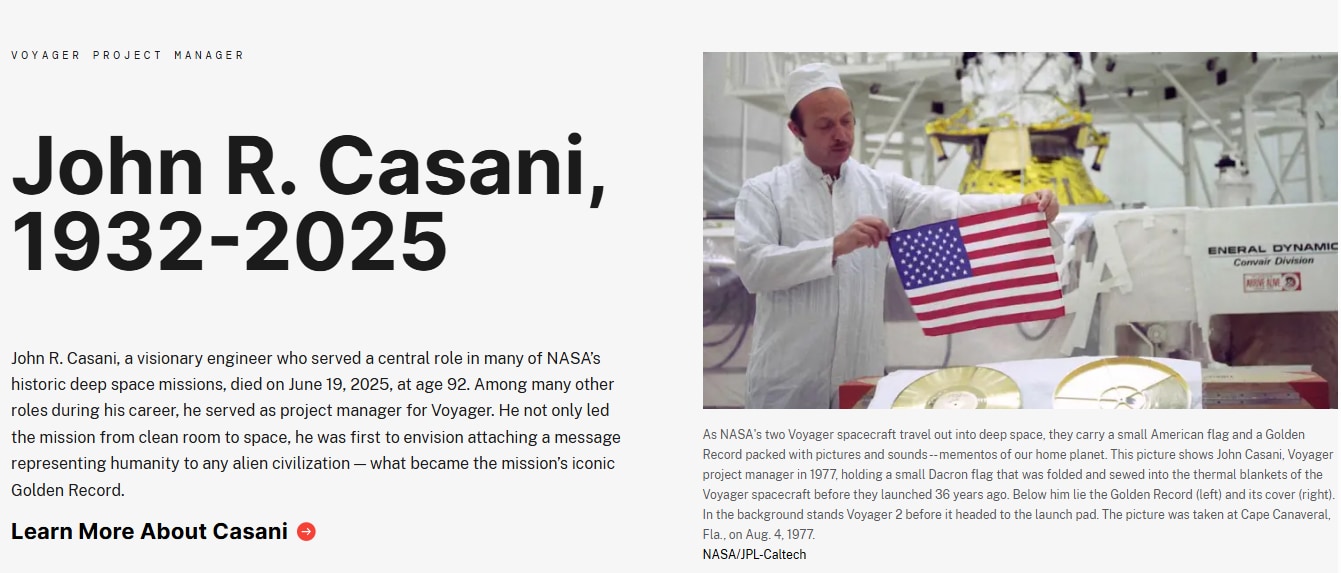
NASA
One Light-Day
Left to fly by Jupiter and Saturn, Voyager 1 has exceeded not only in expectations but also in the distance it has covered thus far. Cruising deep in the cosmos, Voyager 1 will achieve yet another incredible milestone next year when it touches the distance of one light-day.
One light-day is 24 hours, the time it takes light (or radio signals) to travel between Earth and Voyager 1. To get the extent of how far that is, it takes 12 light-minutes for light to travel from Mars to Earth.
The Iconic Golden Record
What if Voyager 1 meets extraterrestrial life during its cosmic excursion? The bright minds on Earth already thought about this before sending Voyager 1 into the deep space.
The golden record, 12-inch gold-plated copper disk, is a time capsule for the aliens to get a glimpse of life on Earth.
The phonographic record attached to both Voyager 1 and 2 carries the sounds of Earth, including those made by nature, humans, animals, and our surroundings.
The record also carries 115 images in analog form. From humans eating to a baby being breastfed, to the wonders of the world. If the alien civilisation does stumble upon the record and can decode the messages, it shouldn’t have difficulty planning a trip to Earth, as the record also bears the location of our planet chalked out using 14 pulsars.
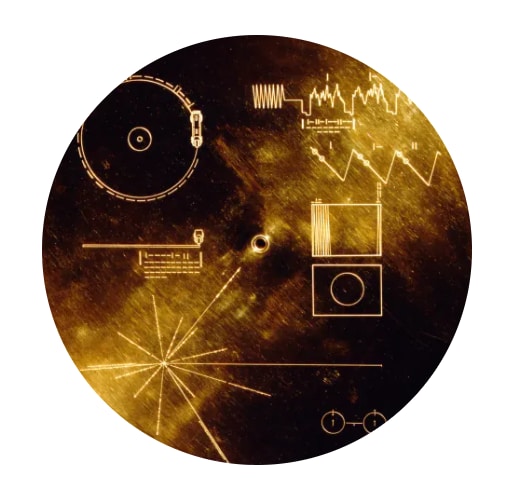
The Golden Record – NASA
The contents of the Golden Record were chosen by a committee led by Carl Sagan of Cornell University.
Track Voyager 1
You can track Voyager 1 from the comfort of your home just by clicking here. Voyager 2, the only human-made object to visit Uranus and Neptune, is on a breathtaking path of its own. You can explore all the achievements secured by the probe here.

The News Desk is a team of passionate editors and writers who break and analyse the most important events unfolding in India and abroad. From live updates to exclusive reports to in-depth explainers, the Desk d…Read More
The News Desk is a team of passionate editors and writers who break and analyse the most important events unfolding in India and abroad. From live updates to exclusive reports to in-depth explainers, the Desk d… Read More
November 27, 2025, 15:26 IST
Read More