The PlayStation Portal is a neat device for handheld gaming, bringing back the charm of Sony’s retired PSP Vita and the vanilla PSP. And thanks to the November update, it can now be used as a standalone device for cloud-based game streaming, much like an ROG Xbox Ally linked to the Xbox Cloud Gaming servers. But it’s still cloud-based game streaming, and in the end of the day, you are going to run into issues. Choppy visuals and pixelation are one of those problems.
One of the most common reasons behind these visual stutters is network interruptions. For cloud-based game streaming, the most important factor is the network bandwidth. As Microsoft — one of the biggest names in cloud gaming – puts it, a bad network connection can result in “blocky, choppy, or distorted visuals.” Additionally, you might also run into random stutters and slow frame refresh. The PlayStation Portal is no different, and that’s why Sony has set a few baseline requirements to enjoy games on the handheld console without any visual quality issues.
Sony recommends a minimum output of 5 Mbps to start a cloud gaming session. Then a minimum of 13 Mbps is required for game streaming at 1080p (full HD) resolution, and 7 Mbps for 720p streaming. The more important fact is the Wi-Fi lane, once you go past the raw speed requirements. Whether you are cloud streaming games directly on the handheld or indirectly from a PlayStation 5, you prefer the 5GHz Wi-Fi band over the 2.4GHz. “Some Wi-Fi routers have a band steering function that allows them to automatically switch between a 2.4GHz connection and a 5GHz connection. If possible, disable this feature when connecting your PS Portal to your Wi-Fi router,” a PlayStation support executive shared with SlashGear during a chat.
A few tips for the best cloud experience
In general, 5GHz is considered the sweet spot, but keep in mind it’s not a magic pill that will work universally. As Intel notes, the 2.4GHz band offers longer range and wall-penetration capability. In a nutshell, your proximity as well as positioning with respect to the Wi-Fi router also matter. Simply put, if you’re focused on the 5GHz lane, sit closer to the router. As one PlayStation Portal user wrote on Facebook, switching to the 2.4GHz band actually improved their experience.
In case you’re still running into pixelation troubles, it’s worth cycling between both bands to see which one offers the best experience. For troubleshooting network-related woes with cloud streaming on the PlayStation Portal, the PlayStation support executive recommended this path: Quick Menu > Troubleshoot > Show Network Status (must be running Portal 6.0 update, or later version). If this doesn’t work, a device restart is recommended. And if that doesn’t solve the slow internet and visual pixelation issues, users are advised to reset the handheld.
Now, the PlayStation Portal is a rather unique device because, when it launched, it was marketed as a companion machine for the PlayStation. Support for standalone cloud-based game streaming landed much later. With that in mind, there are a few other aspects you must pay attention to improve cloud gaming. There’s a whole bunch of other network-related factors that can affect the quality of cloud-based game streaming on the PlayStation Portal. At the basic level, using a mobile hotspot, Wi-Fi extenders, walls between the router and device, too many devices on the same network, VPN, wireless casting, and custom DNS setups are among them.
Some tips for Remote Play
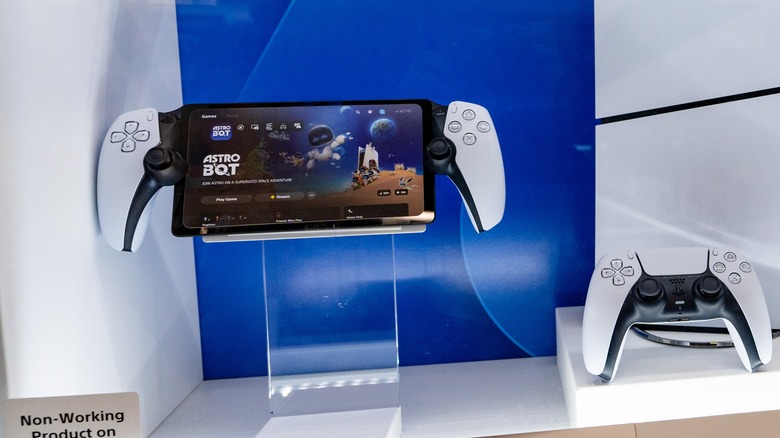
Expanding a bit on the Wi-Fi band situation, you might run into a situation where the default router configuration isn’t set to show the 5GHz band, or a glitch is preventing it from doing so. In such a scenario, you can manually create separate 2.4GHz and 5GHz network profiles by logging into the admin account. Of course, you must know the username and password before you can access the advanced router settings on the network dashboard to create a separate 5GHz band.
https://www.youtube.com/watch?v=MqqrzX-b0vM
On a side note, if you are playing games via Remote Play while connected to a PlayStation 5, you should prefer a hardwired connection to the console, as it provides a smoother, lower-latency experience than a wireless link. And if both devices are connected to a wireless network, try to keep them as close to the router as possible. Users also suggest manually switching the PlayStation to the 5 GHz Wi-Fi band (instead of the slower 2.4 GHz) helps. To do this, follow this path: Settings > Network > Settings > Set up Internet connection > Advanced menu > Wi-Fi Frequency Bands > 5 GHz. You can watch the video below to set it up. Since the PlayStation Portal comes equipped with a 1080p LCD, it’s best to target the native resolution for PlayStation Remote Play streaming, provided your Wi-Fi connection is fast enough.