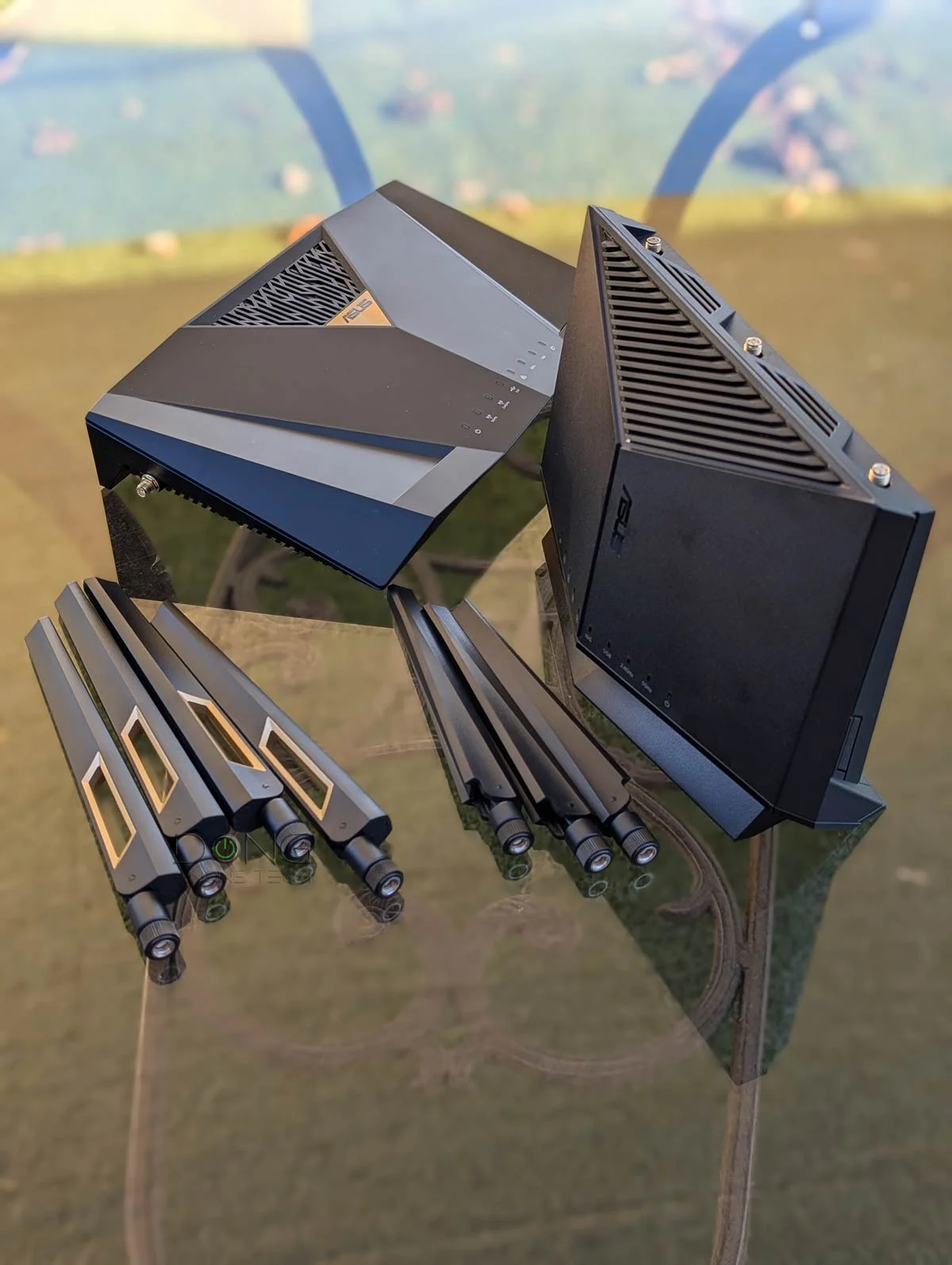
The head says it. This post lists the current best dual-band Wi-Fi 7 routers. They are hardware that does not feature the 6GHz band.
If you want a router with all three bands, pick one from this list of the top “traditional” full-band Wi-Fi 7 routers.
Dong’s note: I first published this frequently revised list on Dec 12, 2024, and last updated it on December 19, 2025.

Five best dual-band Wi-Fi 7 routers: The real-world tested list
Why dual-band, you might ask?
Apart from “why not?”, the truth is that the 6GHz band is complicated, not universally or consistently available, has a short range, and is the source of many connection issues.
How the 6GHz band is regulated around the world
The 6GHz band has a total width of 1200 MHz, ranging from 5.925 MHz to 7.125 MHz, and is divided into 59 channels of 20 MHz each. These channels are grouped to create “sub-bands,” which also vary from one region to another.
In the U.S., the FCC has designated four sub-bands across the entire 6GHz spectrum, including UNII-5, UNII-6, UNII-7, and UNII-8, for Wi-Fi use, though portions of the band may be reserved for other applications.
The E.U. Commission allows only the UNII-5 equivalent part of the frequency for Wi-Fi use, which is 480 MHz in width from 5925 MHz to 6425 MHz. Some other parts of the world are somewhere in between, with the UNII-5 portion adopted and the rest being considered. In the rest, this band may not even be available for Wi-Fi at all.
Generally, Wi-Fi 6E needs a 160MHz channel to deliver the best performance, and Wi-Fi 7 requires double that, 320MHz. Due to spectrum availability and other reasons, real-world hardware tends to use narrower channels in most cases.
Overall, the use of the 6GHz frequency is complicated and is the main reason a Wi-Fi broadcaster made for one region might not work in another.
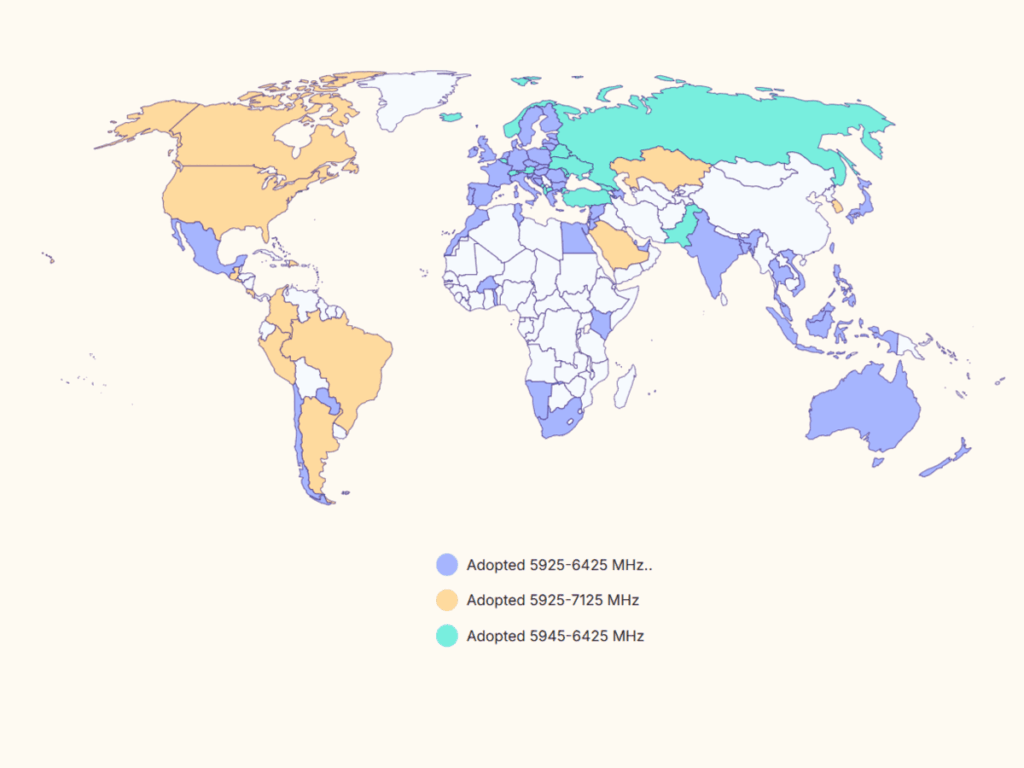
The table below shows its current adoption worldwide. The “Considering” portion is generally slated to be finalized eventually, though that varies from one region to another.
| Country | Adopted Spectrum |
|---|---|
| United States | 5925-7125 MHz (entire band including UNII5, UNII-6, UNII-7, and UNII-8) |
| Albania | 5945-6425 MHz (UNII-5) |
| Andorra | 5945-6425 MHz |
| Argentina | 5925-7125 MHz |
| Australia | 5925-6425 MHz |
| Austria | 5945-6425 MHz |
| Azerbaijan | 5925-6425 MHz |
| Bahrain | 5925-6425 MHz |
| Bangladesh | 5925-6425 MHz |
| Belarus | 5945-6425 MHz |
| 5945-6425 MHz | |
| Belgium | 5945-6425 MHz |
| Bosnia and Herzegovina | 5945-6425 MHz |
| Brazil | 5925-7125 MHz |
| Bulgaria | 5945-6425 MHz |
| Burkina Faso | 5945-6425 MHz |
| Canada | 5925-7125 MHz |
| Chile | 5925-6425 MHz |
| Colombia | 5925-7125 MHz |
| Costa Rica | 5925-7125 MHz |
| Croatia | 5945-6425 MHz |
| Cyprus | 5945-6425 MHz |
| Czech Republic | 5945-6425 MHz |
| Denmark | 5945-6425 MHz |
| Dominican Republic | 5925-7125 MHz |
| Egypt | 5925-6425 MHz |
| El Salvador | 5925-7125 MHz |
| Estonia | 5945-6425 MHz |
| European Union | 5945-6425 MHz |
| Faroe Islands | 5945-6425 MHz |
| Finland | 5945-6425 MHz |
| France | 5945-6425 MHz |
| Georgia | 5945-6425 MHz |
| Germany | 5945-6425 MHz |
| Gibraltar | 5945-6425 MHz |
| Greece | 5945-6425 MHz |
| Guatemala | 5925-7125 MHz |
| Honduras | 5925-7125 MHz |
| Hong Kong | 5925-6425 MHz |
| Hungary | 5925-6425 MHz |
| Iceland | 5945-6425 MHz |
| India | 5945-6425 MHz |
| Ireland | 5945-6425 MHz 6425-7125 MHz |
| Isle of Man | 5945-6425 MHz |
| Italy | 5945-6425 MHz |
| Japan | 5925-6425 MHz 6425-7125 MHz |
| Jordan | 5925-6425 MHz |
| Kazakhstan | 5925-7125 MHz |
| Kenya | 5925-6425 MHz |
| Latvia | 5925-6425 MHz |
| Liechtenstein | 5945-6425 MHz |
| Lithuania | 5945-6425 MHz |
| Luxembourg | 5945-6425 MHz |
| Macao | 5945-6425 MHz |
| Macedonia | 5945-6425 MHz |
| Malaysia | 5925-6425 MHz |
| Malta | 5925-6425 MHz |
| Mauritius | 5925-6425 MHz |
| Mexico | 5925-6425 MHz |
| Moldova | 5925-6425 MHz |
| Monaco | 5945-6425 MHz |
| Montenegro | 5945-6425 MHz |
| Morocco | 5925-6425 MHz |
| Namibia | 5925-6425 MHz |
| Netherlands | 5945-6425 MHz 6425-7125 MHz |
| New Zealand | 5925-6425 MHz |
| Norway | 5945-6425 MHz |
| Pakistan | 5945-6425 MHz |
| Paraguay | 5925-6425 MHz |
| Peru | 5925-7125 MHz |
| Philippines | 5925-7125 MHz |
| Poland | 5925-7125 MHz |
| Portugal | 5945-6425 MHz 6425-7125 MHz |
| Qatar | 5925-6425 MHz |
| Romania | 5925-6425 MHz |
| Russian Federation | 5925-6425 MHz |
| San Marino | 5925-6425 MHz |
| Saudi Arabia | 5925-7125 MHz |
| Singapore | 5925-6425 MHz |
| Slovakia | 5925-6425 MHz |
| Slovenia | 5925-6425 MHz |
| South Africa | 5925-6425 MHz |
| South Korea | 5925-7125 MHz |
| Spain | 5945-6425 MHz |
| Sweden | 5945-6425 MHz |
| Switzerland | 5945-6425 MHz |
| Thailand | 5925-6425 MHz |
| Togo | 5925-6425 MHz |
| Tunisia | 5925-6425 MHz |
| Turkey | 5925-6425 MHz |
| Ukraine | 5925-6425 MHz |
| United Arab Emirates | 5925-6425 MHz |
| United Kingdom | 5945-6425 MHz |
| Holy See (Vatican City State) | 5945-6425 MHz |
| Vietnam | 5945-6425 MHz |
Additionally, Wi-Fi 7 offers improvements across all bands, and the MLO feature can be available without the 6GHz band. So, choosing dual-band Wi-Fi 7 means you can enjoy many of the standard benefits without the headache or the premium cost.
This list is sorted in the recommended order, with the best routers at the top—the numbers indicate the ranking.
By the way, you can use multiple units of all the routers below, except those from NETGEAR, to build an equally straightforward Wi-Fi system, preferably via wired backhauling to extend coverage.
1. ASUS RT-BE86U (BE6800)

The RT-BE86U is ASUS’s second dual-band Wi-Fi 7 router, following the RT-BE88U below. It offers an excellent combination of performance, features, and cost. The practical and nostalgic design can also be a bonus for long-time fans of ASUS.
Like all ASUS routers, the RT-BE86U features AiMesh, and a set of two or more units will give you a true 10Gbps wired network. It’s currently also one of the top routers to have as a mini NAS server.
Pros
Top-tier dual-band Wi-Fi with MLO support and excellent real-world performance
Tons of valuable features, including AiMesh 2.0, Gaming, Guest Network Pro, and VLAN
One 10Gbps and four 2.5Gbps flexible network ports with Dual-WAN and Link Aggregation support
Universal setting backup and restoration; open source firmware; fanless design
Relatively compact design, comparatively affordable
2. ASUS RT-BE88U (BE7200)

The ASUS RT-BE88U is notable for two reasons. First, it’s a top-tier Wi-Fi 7 machine without a 6GHz band. Second, it has 10 network ports, the highest number among home routers, of which six are multi-Gigabit.
Like the RT-BE86U above, it’s part of a long-standing lineage that will keep some ASUS fans happy.
Pros
Top-tier Wi-Fi 7 for 2.4GHz and 5GHz band with 4K QAM and MLO support; excellent performance
Tons of valuable features, including AiMesh 2.0, Gaming, Guest Network, Pro, and VLAN
Ten built-in network ports, six of which are Multi-Gig ports and SFP+ with Dual-WAN and Link Aggregation support
Universal setting backup and restoration; open source firmware; fanless design
Cons
No 6GHz band; no 2nd 10GBASE-T port
3. TP-Link Archer BE230 (BE3600)

The main reason the TP-Link Archer BE230 made it to this list is the fact that it’s incredibly affordable. At $99, it makes Wi-Fi 7 a commodity. In return, it’s a dual-band Wi-Fi 7 router with modest Wi-Fi specs. Still, with two 2.5Gbps ports, it’s an excellent router for many.
Pros
Excellent performance for the specs; super affordable
Wi-Fi 7 and Multi-Gig support; robust web user interface with a good set of network features and Wi-Fi settings
Useful (optional) mobile app; EasyMesh-ready; compact and practical design
Cons
No 10Gbps ports or Dual-WAN; modest Wi-Fi 7 specs
Online protection and advanced parental controls require subscriptions
4. ASUS TUF-BE6500

The TUF-BE6500 is an all-around sensible router for anyone who wants to have a real dual-band Wi-Fi 7 experience with up to 2.5Gbps of bandwidth. As part of the ASUS AiMesh family, you can also get a couple of units to build a robust Wi-Fi system. After that, its built-in gaming features will be bonuses.
Alternatively, check out the non-gaming, single 2.5Gbps port RT-BE58U, which costs significantly less.
5. NETGEAR Nighthawk RS200 (BE6500)

The Nighthawk RS200 is NETGEAR’s first dual-band Wi-Fi 7 standalone router. It comes with top-tier hardware and has excellent performance for its specs. Like all NETGEAR Nighthawks, though, it has a comparatively limited feature set.
Alternatively, you can also consider the Nighthawk S100 and its variants. (Compare their prices!)
Pros
Fast and reliable Wi-Fi for the specs; two 2.5Gbps ports with excellent wired performance
Robust web interface with (optional) complimentary mobile app
Practical, fan-less, aesthetically pleasing design; runs cool and quiet; comparatively low power consumption; friendly pricing
Cons
No 6GHz band or 10Gbps ports, only two 2.5Gbps ports; no standard Remote Management via Dynamic DNS; limited built-in free features
Disjointed web user interface and mobile app; online protection and Parental Controls require the Nighthawk mobile app and premium subscriptions
The final thoughts
Dual-band Wi-Fi 7 is the safe approach to the latest standard. It allows users worldwide to enjoy the latest features without any complications, and in most cases, a dual-band connection is sufficient. If you have sub-gigabit bandwidth needs, any of the routers above will serve you well.