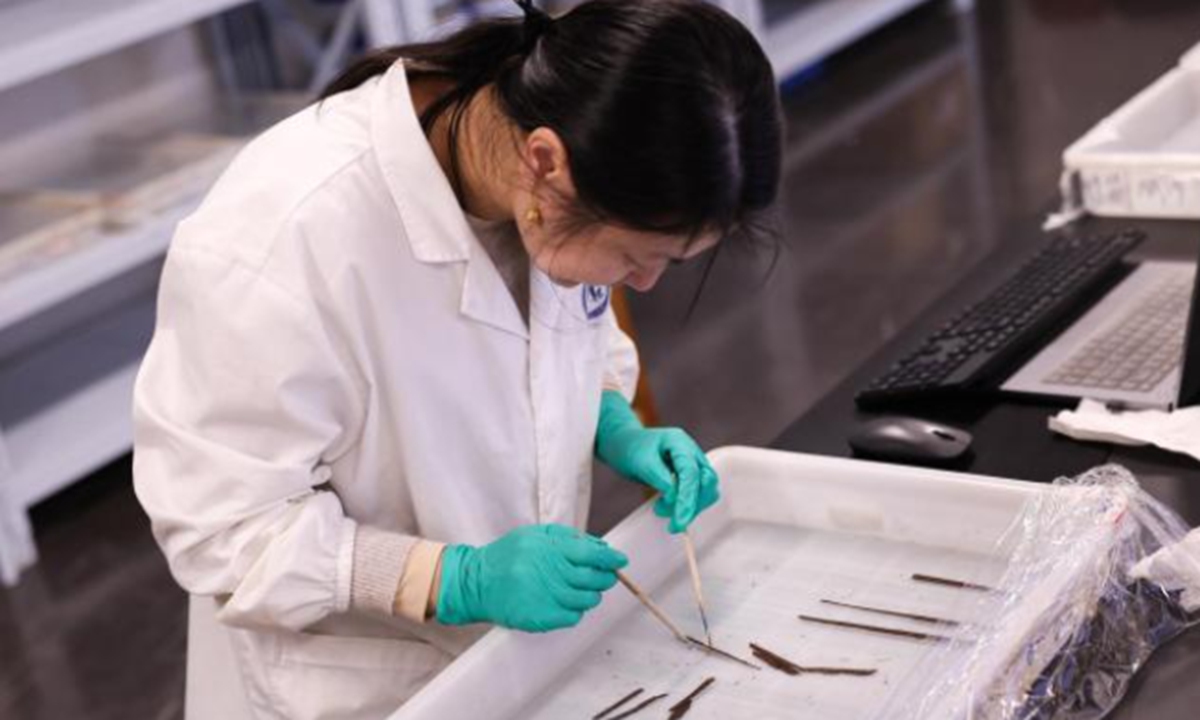
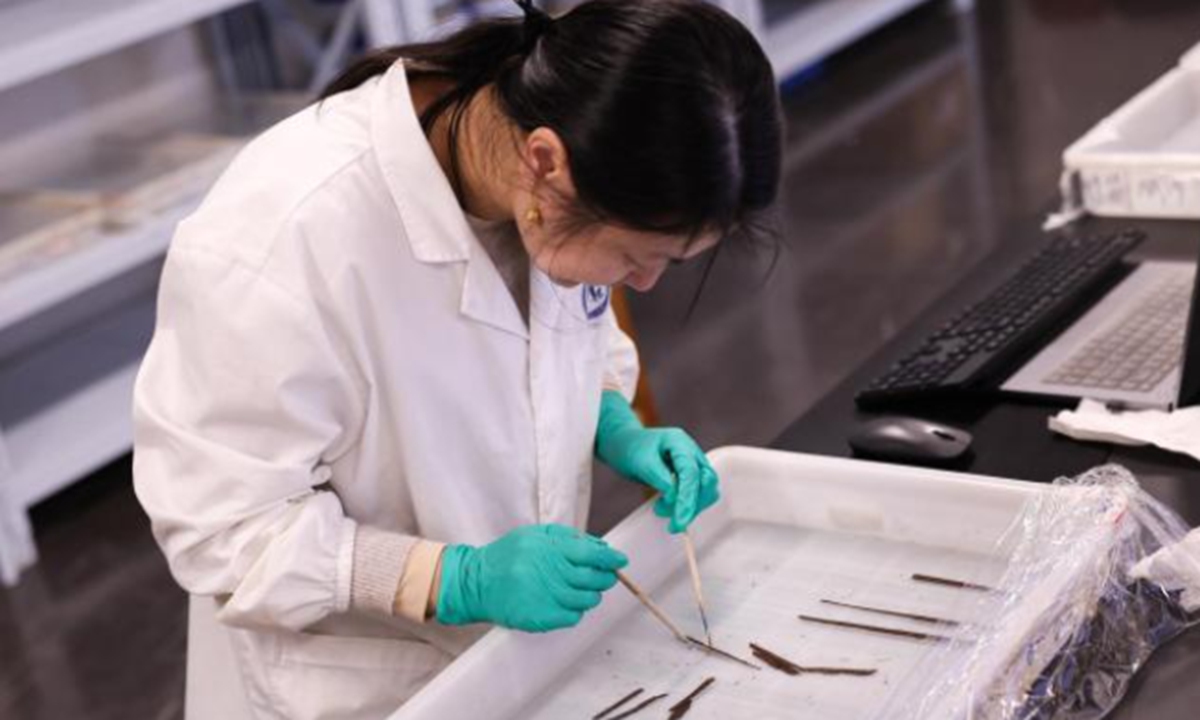
The latest progress in the restoration of the Haihun bamboo slips was unveiled at the 10th anniversary conference on the archaeological discoveries of the Marquis of Haihun tomb in Nanchang, East China’s Jiangxi Province, on Saturday. Among the highlights is the discovery of the first complete version of The Book of Songs (Shi Jing) from the Qin and Han dynasties (221BC-AD220).
“Around 1,200 bamboo slips related to The Book of Songs were unearthed from the Marquis of Haihun tomb,” Yang Jun, head of the Haihun tomb excavation team, told the Global Times on Sunday.
“One slip bears the inscription: ‘Three hundred and five poems in total, 1,076 chapters, 7,274 characters,’ Yang said. “This indicates that the Haihun Book of Songs is a complete version.”
Before the invention of paper, bamboo and wooden slips were the main writing materials used in ancient China. More than 5,000 bamboo and wooden slips were unearthed from the tomb, including over 500 containing The Analects, among which is the long-lost Qi Version of The Analects, according to the China News Service.
“The Qi Version of The Analects unearthed from the Haihun tomb is well preserved, with clear handwriting,” Yang said. “The tops of the slips are neatly trimmed, and there is a blank space before the text begins. The ends are slightly damaged, but no traces of writing have been found there.”
According to Yang, the characters on the slips were written in clerical script with black ink. The handwriting is neat and orderly, and duplicate characters were rewritten instead of using repetition marks, with the overall text remaining largely complete.
In addition to The Analects and The Book of Songs, the Haihun slips also include The Book of Rites, The Spring and Autumn Annals, and The Classic of Filial Piety, which are all ancient Chinese classics.
“These slips reflect Emperor Wu of the Han Dynasty’s policy of promoting Confucianism as the state ideology and collecting a wide range of classical texts,” Yang said.
Fang Beisong, director of the Jingzhou Cultural Relics Protection Center in Hubei Province, noted that the bamboo and wooden slips unearthed from the Marquis of Haihun’s tomb suffered from various forms of deterioration, such as decay, fragmentation, water saturation, and breakage, as well as textual issues like missing, blurred, or deformed characters.
According to Fang, despite the challenges, most of the preservation work has now been completed, and full restoration is expected to be finished by 2026.
In addition to the slips, the tomb also yielded what is believed to be China’s earliest example of suoxiu (lock embroidery).
Yang revealed on Saturday that studies of the textile and decorative artifacts unearthed from the Marquis of Haihun’s tomb identified the use of suoxiu, one of the oldest embroidery techniques in China. From the Shang and Zhou (1046 BC-256 BC) dynasties through the late Han period, suoxiu remained one of the most important methods in traditional embroidery.
According to Jiangxi Release, the suoxiu fragments unearthed from the tomb still retain their vivid colors. It is believed they were embroidered with silk threads dyed with cinnabar. The patterns are stylistically similar to the renowned suoxiu works found in other Han tombs. These embroidered pieces were mostly attached to lacquer box fragments and coffin panels. Although the fabrics themselves were heavily decayed, the stitching techniques and decorative patterns remain discernible, making their extraction an extremely delicate process.
The Marquis of Haihun’s tomb belonged to Liu He, the grandson of Emperor Wu of the Han Dynasty. More than 10,000 artifacts have been unearthed from the site, systematically showcasing the ritual system, craftsmanship, and lifestyle of the Western Han period, according to the China News Service.
Liu He’s tomb complex is trapezoidal in shape, with the tombs of Liu He and his wife at the center. Covering an area of 46,000 square meters, the complex consists of two main tombs, seven subordinate tombs, an outer storage pit, ancestral halls, side chambers, and architectural features such as north and east gates with gate towers. The site also contains remains of roadways and drainage systems, according to the Guangming Daily.
The design of Liu He’s burial chamber was modeled after the actual living environment of the tomb owner during his lifetime. It is structurally complex and architecturally advanced, with each section functioning independently yet interconnected. The tomb passage extends directly to the bottom of the chamber, allowing access to all areas of the coffin chamber.
“The most distinctive feature of Liu He’s tomb complex is its highly residential and courtyard-like design, which reflects the burial system based on the ‘Han style’ promoted nationwide during Emperor Wu’s reign,” Yang said.
Since the excavation of the Marquis of Haihun’s tomb began in 2011, more than 10,000 valuable artifacts have been unearthed, providing significant insights into the political, economic, and cultural life of the Han Dynasty in China, according to the Nanchang Han Dynasty Haihunhou Heritage Administration.